Monday, 20 May 2013

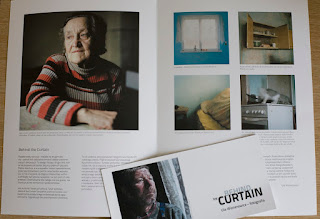
PIEL de PHOTO issue 14 has been personally delivered into my hands straight from Barcelona during the launch of the magazine in London at LCC organised by Photography and the Archive Research Centre & PIEL de FOTO 


Wednesday, 3 April 2013

Oh Comely- editorial portriats

Issue 15 of Oh Comely magazine with the image of Saudi Arabia's first female director and the portraits of mothers and daughters has arrived today:


Tuesday, 2 April 2013

Someone I know

I had a real pleasure to participate in the latest project Someone I Know curated by Stuart Pilkington. Check my image (portrait of Julija) as one of the many others:http://www.someoneiknow.net/ulawiznerowicz.html

Monday, 7 January 2013

'Its a strange mixture between harshness and love'

I have been recently participating in a show curated by Anna Andronova and Sylwia Krason called Wrong Door Pop Up Project at The Wrong Door Art Gallery. Here is a short review:'Polskiego są tak' about my work written by Rodrigo Orrantia, art historian and photography curator. Ceck the images from the opening night.

Tuesday, 6 November 2012

Review of Behind the Curtain


Time for a small update about my work. After a month long exhibition 'Behind the Curtain' has been recently taken down from the wall of Balucka Gallery in Lodz, Poland. Here is a nicely designed brochure and a interesting review about my project.


Ula Wiznerowicz: Images from Behind the Curtain


Behind the Curtain is the title of a cycle of photographs that Ula Wiznerowicz has carried from the world of her family and childhood into a vision of painful, incurable modernity. Wiznerowicz tenderly unmasks a world of people convinced that they cannot be seen. It is a major problem not only in Greater Poland but in countless other places.
She has written about her own exhibition: ‘Forgotten and useless things covered in dust, emaciated cats running around searching for leftovers, rooms taken over by spider webs and a strong odour of alcohol. This was merely a part of the chaos that I encountered while photographing my native village, Palmowo and the surrounding areas in Poland where I grew up.The series of photographs represents a personal journey through individual stories of the men and women dealing with alcoholism. Not all the characters are necessarily alcoholic, but everyone has been affected by alcoholism, through family or friendship.’
A dirty glass balanced on an old chair, a filthy, overflowing ashtray, a TV remote control, a cigarette lighter and an alarm clock: these objects form part of the composition of one of the photographs, the attributes of a human world which are the subject of Wiznerowicz's creative gaze. It is an image of squalor and sorrow, an image of helplessness, of losing oneself in lost memories. A conclusion of sorts: a closed composition.
The value of this exhibition is manifold. The motivation behind it (rather than the inspiration?) was concern for humanity with all its beauty and ugliness and an intelligent desire to find one's own roots. 
Besides a handful of landscapes which depict the milieu in which the subjects of the photographs spend their daily lives, the photographs of Wiznerowicz frame people, some in portraits from which there is no escape, others showing  objects, still warm, only recently touched, or left to go cold as life no longer allows their owners to tidy them up.
As a photographer Wiznerowicz doesn't take pictures from the front row, she rejects her privileges, free passes to an unfamiliar world. She feels the chill of the stage along with the actors, touches the props but doesn't move them, doesn't interfere, doesn't impose. She tries to gently knit her presence into the tattered hair of these difficult human stories. She looks and immortalises. The faces and objects say all there is to say.
Almost every image carries a commentary, words penned by the photographer herself (‘I got used to the piles of junk and clothes scattered around the flat, the dirt and the horrible smell. It was quite dark, the room was engulfed in clouds of cigarette smoke. Cats were running from corner to corner, like crazy, trying to find something to eat. But nobody took any notice and nobody was bothered that I was there, as they opened another bottle of vodka.’) or one of the characters (‘When there's no alcohol to pass around your friends don't come round. It's hard then.’) They are not forceful or intrusive, they merely confirm our intuitions and add to the stories told by the images. 
These days it is easy to take photographs – everyone can do it and that's the problem. What is captivating about the work of Ula Wiznerowicz is a lack of engagement with technology, an honest tolerance of imperfection whenever it appears. This is a cautious approach to photography, observant of the limits of good compositional taste but also of the right of objects to exist in the frame. The faces of the subjects of this sorry tale have not had the signs of their difficult experiences edited out, Wiznerowicz does not taint them with fakery.  Her tweaking of colour and dynamics is justified by the narrative: a bright, optimistic window with a lamp and some fruit on a windowsill. The caption contains the words ‘I died and at 50 years old was resurrected from the dead.’, which justify the bright light. Those who speak openly about themselves have brightened, sharpened features. They stare into the light or the darkness depending on their outlook on the future. The portrayal of cats is exceptional; because they are constantly moving, chasing after food, the photographer lets them blur, allowing them a feline individualism.
And so in the same way that a single strand of DNA captures a unique human form and the shape of the body and how it speaks tells a trained eye of its condition, every photograph in the cycle Behind the curtain is a closed narrative world capable of transparently corresponding to the image hanging beside it. An honest cycle, a tale.
By Jola Sowińska-Gogacz, Translation by: Greg Goodale

Wednesday, 12 September 2012


'Behind the Curtain' is being shown at Balucka Gallery in Lodz, Poland.
 Opening reception:
September 18 at 5pm. 


Friday, 10 August 2012

My portfolio has been chosen AGAIN as part of 100 Curators 100 Days Project, this time by Didier Damiani, Luxemburg

Thursday, 2 August 2012

2012 Daylight Photo Award, juror's pick: Ula Wiznerowicz, Behind the Curtain


I am so pleased I was selected as a juror's pick of the 2012 Daylight Portfolio Award.
CDS Publishing and Awards Director Alexa Dilworth describes what drew her attention as she made her way through hundreds of portfolios submitted for the 2012 Daylight Photo Awards, and what distinguished the body of work she ultimately chose: 

In the end, I could only go with the portfolio that drew me in the most, that compelled me to consider it the longest, with utmost attention and feeling: Ula Wiznerowicz’s Behind the Curtain. Below is the juror’s statement I wrote for Michael and Taj for their use in announcing the 2012 Daylight Photo Awards winner and jurors’ picks:
                 
                     From 'Behind the Curtain' Photograph by Ula Wiznerowicz 

“Ula Wiznerowicz’s photographs in Behind the Curtain come together in the way a collection of short stories might, stories woven together to tell a larger story both elusive and straight-up sad and difficult. Ula went back to the place she grew up, Palmowo, Poland, to photograph place, people, and problems—specifically, men and women struggling with alcoholism, either themselves or collaterally. And she was also looking at, thinking about, her own past. As she says, ‘I know all of the people in my pictures, their wives, children, the interiors of their homes, and the views from their windows.’ This understanding is manifest in her pictures. Rather than put a frame around public, more predictably dramatic, portrayals of her subject, she shares with us a private view, an atmosphere, a way of being that she both reveals and creates. The formalism of the photographs plays both against and with the tumult, resignation, and loneliness of these very particular lives lived out in a quiet, slowly disappearing community. I found myself revisiting this world behind curtains over and over. The quotes that accompany the photographs—as spare yet revealing as the images—drew me further into these rooms where people sit, wait, sleep.”


Sunday, 29 July 2012

Down the drain

I came across this article which shows the consequences of Tomislawice Mine's works.
Down the drain, by Wojciech Kosc
A large, shallow lake in Poland could disappear if an open-cast mining project goes ahead.
Lake Goplo is Poland's ninth largest lake. It covers an area of 21.8 square kilometres and has an average depth of 4.4 metres. The Lake Goplo Nature Park, part of the Natura 2000 network, spreads out over more than 2,300 hectares, while the expanded protected area is more than 10,000 hectares.
The lake is also linked to the very beginnings of Polish statehood. There's some, albeit feeble, archaeological evidence that a Slavic tribe which settled around the lake might have later progressed to become the leading force in bringing together what is now the territory of Poland under more or less unitary control.
An old legend has it that a rogue king residing by the lake treacherously poisoned his power rivals and threw their bodies into Lake Goplo. He didn't get away with the crime, however, as thousands of rats emerged from the lake, cornered the king atop the castle tower and ate him.
Thus Poles thinking about Lake Goplo entertain quite a mix of factual and cultural information. But it isn't the lake's stuff of legend that made newspaper headlines recently.

                            image © Ula Wiznerowicz
             

Saturday, 28 July 2012

New project

With a useful advises from Steven Macleod and help from Diane Smith my new project has got its shape now and it's almost finished. Here is a small selection of 'Displacement; photographs from the shadow of the Tomislawice Mine'.


‘Displacemen; photographs from the shadow of the Tomislawice Mine’:

In January 2010 the ‘Konin’ mine opened in central western Poland. A series of open pits scattered across the area it is run by the State owned company Konin Mine, which extracts brown coal to be used by power engineering industry.

Lignite or ‘brown coal’ supplies 93 percent of Poland’s energy and three nearby power stations burn materials from the Konin mines. The initial impact of open cast mining is very physical, with local lakes disappearing, forests drying up water supplies dwindling. Local residents and Greenpeace activists argue that open-cast mining, which sucks up water within a several-kilometre radius, will rapidly drain the shallow Lake Goplo within few years.

I documented and interviewed the families who have been left on the edge of The Tomislawice Stripmine, both those that have stayed and those that have received new housing through compulsory displacement or voluntary relocation packages. 


                         all images © Ula Wiznerowicz

PHOTO/arts Magazine: Ula Wiznerowicz

My project 'Behind the Curtain' was published at the PHOTO/arts Magazine which is a compendium of photography and contemporary art topics. Created in 2006. Christopher H. Paquette is the editor and founder.

Thursday, 26 July 2012

Behind the Curtain in Rybnik, Poland

My project 'Behind the Curtain' will be exhibited in DeKa Gallery in Rybnik, Poland from the 1-31 August 2012 

100 Curators 100 Days Project

I am very pleased that my work has been chosen by Matthias Harder, chief curator at the Helmut Newton Foundation in Berlin as part of the project 100 Curators 100 Days run by Saatchi Online.


100 Curators 100 Days' is a major initiative that recognizes talented emerging artists from around the world. It was developed by Rebecca Wilson, Director of the Saatchi Gallery, London and is the inaugural exhibit under the helm of Saatchi Online's new CEO, Margo Spiritus. Each day for 100 days, work selected by curators from the world's most prestigious museums and galleries will be revealed.
Click here to view it

Saturday, 30 June 2012

I'm thrilled to take part in The Nighttime Projection: Women in Photography as part of the Photoville. Join FotoVisura on June 30 at 8.30pm at Pier 3 Uplands Brooklyn Bridge Park, New - York!

Thursday, 21 June 2012

Memories from Palmowo

In maximum 10 years the memory of the place I grew up will exist only on the pictures. My hometown and another 11 villages will be literally removed so the coal can be exposed. The mine is not giving up.. 
While I have been working on a coal mine project I have decided to document my home town by capturing simple, ordinary things rather optimistic and bringing good memories so I can keep it, before everything gets completely destroyed..


                            © Ula Wiznerowicz

Wednesday, 20 June 2012

Behind the Curtain in Suwalki, Poland

W suwalskiej galerii „Pacamera” pojawiły się fotografie autorstwa Uli Wiznerowicz, na których nawet szara rzeczywistość wydaje się barwna:   Niebywalesuwalki.pl

Thursday, 31 May 2012

FotoVisura Grant Exhibition

I'm thrilled to take part in FotoVisura Exhibition at United Photo Industries, New York


The FotoVisura Grant Exhibition
 Sponsored by the Viso Lizardi Family
May 30th to June 17th, 2012 • United Photo Industries • 111 Front Street, Suite 204 • DUMBO Brooklyn NY 11201

Photo by Erin Trieb, 2011 FotoVisura Grant Winner
Curated by Adriana Teresa and Graham Letorney, the FotoVisura Grant Exhibition will be
presented at the new United Photo Industries Gallery in DUMBO, Brooklyn.
Opening Reception
Thursday May 31 from 6pm - 9pm
First Thursday Gallery Walk
Thursday June 7 from 5pm - 9pm

A Group Show Featuring

Erin Trieb, Thomas Michael Alleman, Brad Vest, Anastasia Taylor Lind/VII, Ula Wiznerowicz
Dimitri Mellos, Laura El-Tantawy, Sebastian Liste, Annabel Clark, Marcia Michael, Ivor Prickett
Wendy Marijnissen, Melissa Cacciola, Kai Loeffelbein, Emily Schiffer, Matt Eich/Luceo
Justin Maxon, Elizabeth Herman, Pete Pin, and Amnon Gutman.
United Photo Industries is a Brooklyn-born, art-presenting cooperative dedicated to identifying, harnessing, and occasionally conjuring unexpected exhibition opportunities. All in the name of fostering conversation, championing new directions in photography, and cultivating ties within an ever-expanding, globe-trotting community of photographers.
www.unitedphotoindustries.com 
www.fotovisurapavilion.com


Curatorial Statement

Curated by Adriana Teresa and Graham Letorney—The FotoVisura Grant Exhibition features a selection of thirty images by twenty members of the FotoVisura international photography community, who were recognized for their personal projects by a panel of renown editors and curators in either the 2010 or 2011 FotoVisura Grant competition.
FotoVisura is about community as much as photography. Together, we stand for respect, tolerance, awareness and compassion, as well as, the understanding that one can exercise his or her freedom of expression within a space that believes that we can co-exist and grow in the difference.
This exhibition is a testimony to the broad spectrum and high quality of personal projects produced by the members of the FotoVisura community. Using their own resources, each photographer has taken it upon themself to bring to light a story that they feel strongly about. Some expose and even risk their own life during the process, yet all have become a voice to many who do not have one.
FotoVisura Inc. is committed to supporting these photographers during the process.

Wednesday, 23 May 2012

Clare Uchima

Here are some pictures from the session with Clare in Dumfries, Scotland.

                                © Ula Wiznerowicz

Monday, 21 May 2012

'Between Homes' at PDPL

My project 'Between Homes' has been published by Polish Documentary Photography LinksCurated by Ewa Meissner of Napo Foundation and Napo Images agency in Poland. One of Ewa Meissner's and Napo Foundation's goals is to promote Polish documentary photography internationally. PDPL on weekly bases publishes links to new stories by leading Polish documentary photographers and photojournalists as well as aspiring fresh talents.